

Nobody wants to deal with skirting that warps or peels before the client even moves in. It usually happens when the material choice doesn’t account for the daily wet mopping or the high humidity we live with across the Klang Valley.
This guide from Sun Synergy provides a set of instructions to help you pick materials that protect your wall finishes and keep that corporate look sharp, even with heavy traffic. To ensure your wall skirting withstands the environment here in Malaysia, you’ll learn about:
- Picking materials that handle local humidity and daily cleaning cycles.
- Integrated options from Progress Profiles for hiding office cables.
- How to avoid the maintenance calls caused by poor material selection.
Every project comes with its own set of challenges when working across our local office parks. A high-traffic hallway in the KL CBD does not face the same wear conditions as a quiet studio in Petaling Jaya.
That is why your choice of wall skirting across Malaysia matters more than you might think. The right skirting stops heavy mops, rolling office chairs, and constant foot traffic from destroying your wall finishes before the lease is even up.
Working with experienced suppliers can help ensure the right profile is matched to each office setting and site condition.
Picking the Right Materials for Your Site Conditions
Kuala Lumpur’s climate is notoriously brutal on interior finishes. Constant air-con cycling and high external humidity turn standard timber skirting into a liability. It warps, rots, and pulls away from the wall.
To ensure a lasting result for your client, you need skirting materials that handle these stresses while keeping a contemporary look.
Anodised aluminium is a durable and widely specified option for commercial environments. It is fire-resistant, sleek, and survives the heavy-handed vacuum cleaner impacts that ruin lesser materials.
For a subtle, minimal look, low-profile aluminium skirting options in brushed or anodised finishes can sit flush against the substrate.
If your design involves plasterboard, the Proskirting channel creates a flush, architectural finish that integrates with the wall design.
For premium boardrooms, stainless steel provides a polished skirting finish that is virtually indestructible. The Skirting 80 in stainless steel is the professional choice for areas requiring high hygiene standards and a clean, high-tech look at the floor level.
If you are dealing with curved walls or irregular architectural features, flexible vinyl resin is your most effective skirting fix. The Procap S is a non-toxic flexible vinyl resin profile that works perfectly for finishing the joint between vinyl flooring or carpet and the wall, especially in tight corners where rigid materials fail.
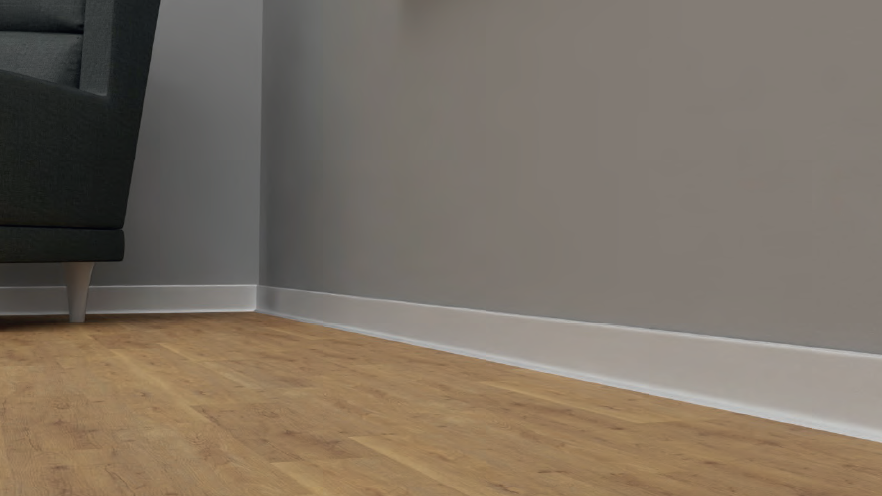
Try These Practical Benchmarks on Your Next Site
Before you lock in your schedule of finishes or hand the keys over to the client, run these site-tested benchmarks against your project to avoid a messy handover or expensive maintenance calls later.
- A general guideline is to proportion skirting height to ceiling height and room scale.
- Prioritise moisture resistance by selecting waterproof materials, like Anodised aluminium or Vinyl resin, to prevent the swelling and mould growth commonly found in timber when exposed to daily wet mopping.
- Ensure high-impact protection in busy areas by using hardened profiles, such as stainless steel or heavy-duty PVC, which can withstand the constant physical force of heavy office chairs and cleaning trolleys.
- Use style coordination to change the feel of a room by matching your skirting to your floor to make a tight 10sqm office look wider, or by using a contrasting 100mm dark walnut profile against light walls for a bold architectural look.
- Solve cable clutter with integrated raceways by opting for profiles like the Proskirting led system, which allows you to hide messy PC and telephone wires within an 80mm high internal channel.
Get in touch to discuss profile options, material samples or project requirements. Explore the full range of commercial wall skirting solutions suited to office environments in Malaysia.
FAQS
What is the standard height for office wall skirting in Malaysia?
While standard residential skirting is often 60mm, commercial projects in the Klang Valley usually require 100mm to 150mm. A 100mm profile is standard for executive offices, but we recommend 150mm for corridors to protect walls from heavy-duty industrial cleaning machines and rolling mail trolleys.
Do tall skirting boards make a room look smaller?
No. Interior trim, especially skirting boards, creates a visual foundation for the room. It defines where the wall ends and the floor begins, and that boundary plays a huge role in proportion. Taller trim gives walls more visual weight and can actually make a room feel more substantial and architecturally balanced.
What is the difference between skirting and skirting boards?
They are the same thing. In Malaysia, builders often use the term “skirting” for the protective board at the floor, while architects and interior designers might refer to it as “skirting boards” in their schedule of finishes. Both serve to hide the expansion joint between the wall and your flooring.
